


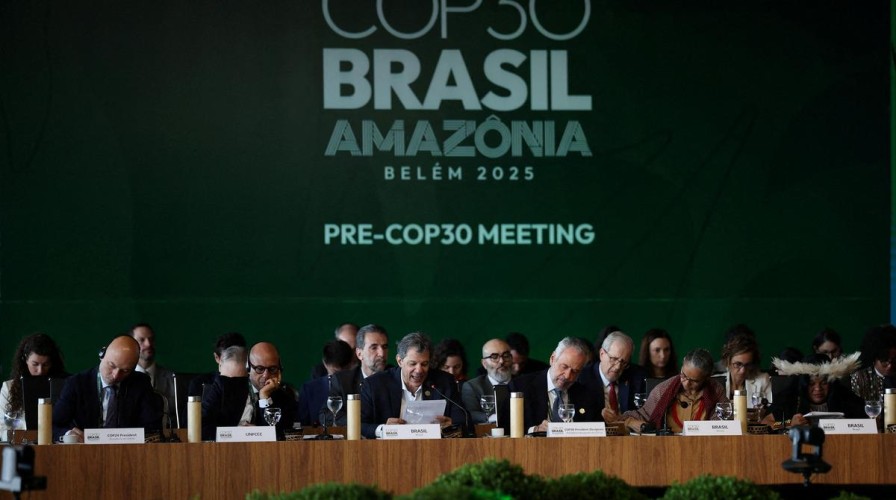
During the Leaders’ Summit of the United Nations Climate Change Conference, or COP30, in Belém, Brazil, India reiterated its commitment to equitable climate action and asked wealthier nations to expedite emission cuts and fulfil long-standing financial commitments.
Ambassador Dinesh Bhatia, who delivered India’s national statement, stated that New Delhi is still dedicated to taking climate action that is informed by equality, national circumstances, and the idea of shared but distinct responsibilities and capabilities.
He claimed that COP30, which was held in Belém from November 10 to 21, was a “moment for reflection” on the world’s advancements since the Rio Summit in 1992 and the Paris Agreement in 2015. He went on to say that such turning points established the groundwork for the current global climate framework. India attended as an observer and praised Brazil’s establishment of the Tropical Forests Forever Facility. The initiative’s goal is to inspire sustained international action in support of tropical forest conservation.
Bhatia noted India’s support for sustainable land management and nature-based solutions, saying, “This step reflects collective resolve to safeguard the planet’s green lungs.”
According to Bhatia, low-carbon growth was a key component of Prime Minister Narendra Modi’s development strategy for India. The nation reduced the emission intensity of its gross domestic product by 36% between 2005 and 2020.
More than half of India’s installed power capacity currently comes from non-fossil energy, enabling it to meet its updated nationally determined contribution target five years ahead of schedule.
Additionally, he stated that between 2005 and 2021, India’s increased forest and tree cover produced an extra 2.29 billion tonnes of carbon dioxide equivalent.
The nation now produces around 200 gigawatts of installed renewable energy, making it the third-largest generator in the world. Through programmes like the International Solar Alliance, which already has over 120 member nations, Bhatia emphasised India’s leadership in the global climate movement. The partnership enhances South-South collaboration while advancing reasonably priced solar energy.
Global ambition is still insufficient, according to Bhatia, notwithstanding advancements made by developing nations. The remaining global carbon budget is fast decreasing, he said.
“Developed nations must provide the promised, sufficient, and predictable support and accelerate emission reductions,” he stated.
He emphasised that developing countries must have access to inexpensive financing, technology, and capacity-building in order to carry out ambitious climate targets. He went on to say that equitable and concessional climate finance is still essential to reaching global goals.
Bhatia reaffirmed India’s belief in the Paris Agreement and multilateralism, saying that implementation, resilience, and shared responsibility should be the main focuses of the next ten years of climate action.
“Targets by themselves are insufficient,” he stated. “Actions must be inclusive, equitable, and ambitious — based on mutual respect and trust.” India’s COP30 declaration emphasised that in addition to establishing new goals, the conference should produce concrete results and enduring alliances for a sustainable future.







Comments are closed