


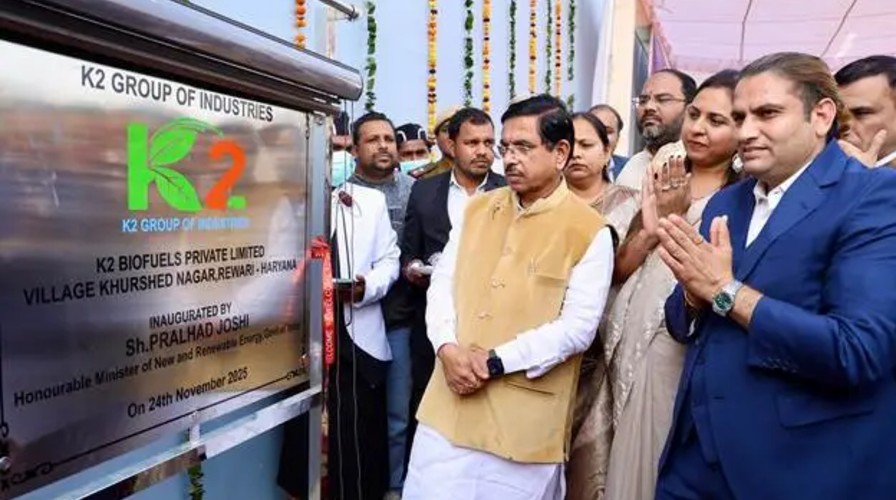
Pralhad Joshi, India’s minister of renewable energy, recently inaugurated a biomass pellet mill in the Rewari district of Haryana, claiming that as the state quickens its transition to clean energy, the facility will reduce emissions and provide farmer income opportunities.
According to Joshi, co-firing biomass pellets or torrefied waste-based charcoal is now mandatory for all coal-fired power stations in India. In the Delhi National Capital Region, units must blend 7% biomass by weight, whilst plants must blend 5%.
He went on to say that local stubble and rice residue must provide at least half of the biomass used by NCR plants. This seeks to boost regional supply chains while reducing seasonal burning. Additionally, the government is strengthening regulations to better separate municipal waste and enhance control over charcoal made from waste. The facility, which can produce 240 tonnes per day, would turn cotton stalks, mustard straw, and paddy straw into pellets for thermal power plants. According to Joshi, this will lower pollution and generate employment in rural areas. Additionally, it will give farmers a new source of income.
According to him, the project supports Prime Minister Narendra Modi’s need for a more sustainable and safe energy system. As grid capacity increases and power generation spreads across the country, Haryana stands to gain. More than 2.8 gigawatts of renewable energy capacity, including 2.4 GW of solar, have been installed in Haryana. Under the PM Surya Ghar project, over 2 lakh households have applied, and 45,000 homes currently have rooftop systems installed.
The state has installed about 1.74 lakh solar pumps and added 18.61 MW under Component A under the PM-KUSUM initiative. Instead of using diesel for irrigation, these pumps enable farmers to use sunshine. Joshi described this as a significant change in the way farmers participate in the production of energy. Haryana is spearheading early hydrogen projects in Hisar, Panipat, and Jhajjar, according to the ministry. He pointed out that the state has almost 49 MW of waste-to-energy capacity spread across 26 units and more than 1,350 MW of biomass potential.
According to Joshi, these developments put Haryana in a strong position to dominate the world market for clean fuel. The people of the state, who are renowned for their contributions to food production and national security, are now leading India’s clean energy future, he continued.
Operating along the clean-fuel value chain, K2 Group is headquartered in Rewari. Its businesses create pellets from agricultural waste for co-firing in thermal plants and generate power from biomass.







Comments are closed