


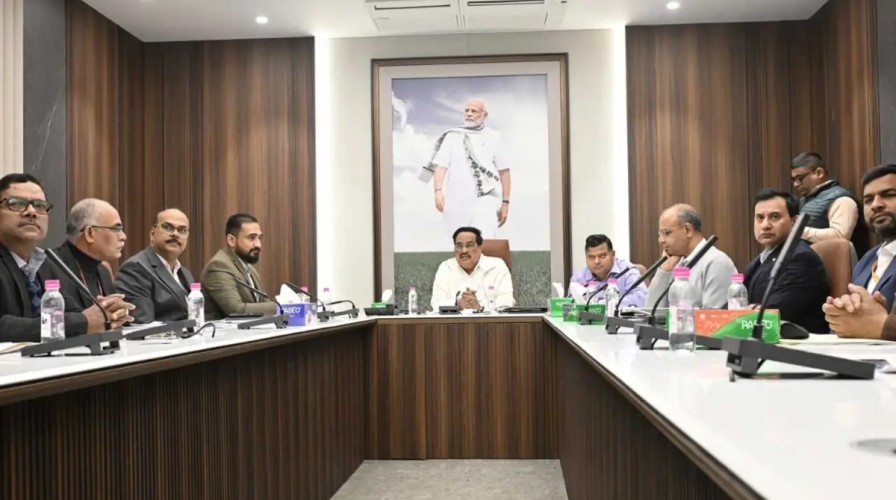
India expanded the government’s digital public infrastructure initiative on December 10th by launching the Sujalam Bharat App, which would revolutionise the tracking, management, and governance of rural drinking water systems across the country.
State representatives and technical agencies attended a nationwide event where Union Minister of Jal Shakti C.R. Patil unveiled the platform. He presented the rollout as a key component of Viksit Bharat 2047, India’s long-term infrastructure goal.
Every rural drinking water programme is integrated into a single national registry by the app. It provides administrators and citizens with real-time access to supply performance, quality indicators, and water assets.
The platform would replace disjointed reporting with a uniform national data architecture throughout India’s rural water sector, according to Jal Shakti Ministry officials. Water sources, asset inventories, scheme designs, operational records, water quality reports, supply indicators, and community comments are all combined into one digital platform by the Sujalam Bharat App.
A Sujal Gaon ID, which digitally connects homes to the drinking water plan that serves them, would be issued to each rural habitation. This structure makes it possible to track infrastructure status and supply reliability at the village level.
According to Patil, “This is a very important launch for the Jal Jeevan Mission.” “It deepens community ownership and strengthens transparency.”
The Bhaskaracharya National Institute for Space Applications and Geo-informatics, or BISAG-N, provided technical assistance to India as it constructed the platform. The georeferencing system that drives district-wide rural water digitisation was developed by the agency. In terms of population coverage, the Sujalam Bharat App represents one of the biggest national rural water digitisation deployments globally.
The database is connected to the PM Gati Shakti GIS platform in India. Planners can overlay rural water networks with communication, power, and transportation infrastructure because of this connectivity.
This can lead to shorter maintenance times and more accurate infrastructure design. Officials anticipate that during droughts and floods, the digital mapping will reduce service interruptions.
Additionally, asset condition and maintenance history will be recorded in the registry. Predictive budgeting and long-term system resilience will be supported by that data.
According to senior Jal Shakti Ministry officials, the platform reduces information gaps between village councils, districts, and state departments while strengthening institutional supervision. In an indication of swift national adoption, representatives from every state and union territory participated in the online debut.
The Department of Drinking Water and Sanitation’s secretary, Ashok K.K. Meena, advised states to adhere to organised deployment plans and incorporate data as soon as possible.
The Sujalam Bharat App and its national database’s technical design were described by T.P. Singh, director general of BISAG-N. According to him, the platform facilitates standardised digital operations for rural water schemes.
BISAG-N held comprehensive training sessions for state officials following the debut. The sessions concentrated on asset integration, georeferencing protocols, and app functionality.
According to officials, this action will improve data accuracy at the state and district levels while lowering implementation risks in the early stages.





Comments are closed