


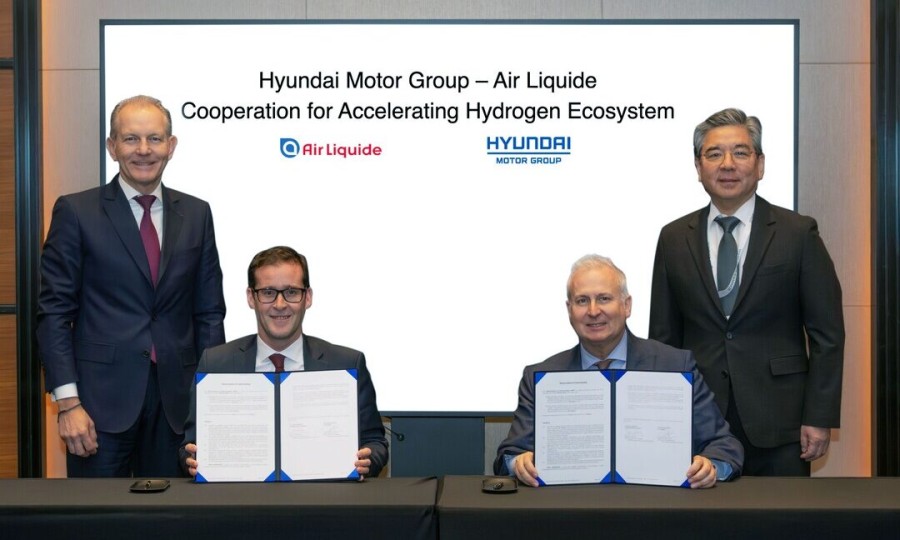
In an effort to hasten the expansion of the global hydrogen economy, Air Liquide and Hyundai Motor Group extended their strategic alliance. Their aim of developing a complete hydrogen value chain spanning Europe, the US, and South Korea is sharpened by this action.
The firms announced the updated memorandum of understanding during the Hydrogen Council CEO Summit, which took place in Seoul from December 2 to 4. The two businesses co-chair the trade association.
The relationship has grown to include more than just hydrogen mobility. Production, storage, transit, and use are all included. The businesses therefore want to create a complete and long-lasting hydrogen ecosystem.
The partners will focus on expanding the use of hydrogen in public transportation, logistics, and heavy-duty transportation. These industries are now at the centre of the new cooperative phase.
Air Liquide will provide technological know-how for infrastructure and hydrogen systems. Hyundai Motor Group will contribute its expertise in fuel cell transportation and mobility. The businesses together declare that they will back the shift to carbon neutrality.
“We are thrilled to deepen our collaboration with Hyundai Motor Group,” stated Armelle Levieux, who oversees hydrogen operations for Air Liquide and is a member of the executive committee. “Building the hydrogen economy still requires collaboration throughout the value chain.” The businesses will build hydrogen centres in South Korea, Europe, and the United States as part of the renewed partnership. These hubs will serve as the foundation for logistics, storage, and refuelling projects.
In order to meet the growing demand, the partners will first extend their networks for hydrogen refuelling. In order to guarantee a steady supply, they will also expand storage capacity.
They will also endeavour to create a dependable hydrogen supply chain that includes transportation, distribution, end usage, and low-carbon and renewable production.
The mobility of hydrogen will continue to be a primary concern. The businesses intend to bring fuel-cell electric vehicles to market for a variety of uses. These consist of port operations, public transportation, and logistics fleets.
The partnership will also hasten the development of hydrogen technology. According to the firms, this initiative will help other important industrial areas as well as mobility.
The partners want to make hydrogen a workable worldwide solution, according to Ken Ramirez, head of Hyundai Motor Group’s energy and hydrogen business division. “From production to utilisation, we are constructing a strong hydrogen value chain together,” he stated. In South Korea, the collaboration has already yielded noticeable outcomes, which the businesses claim offers a solid basis for future expansion in other areas.
Over 2,000 hydrogen buses have been distributed statewide by Hyundai. Additionally, 37,000 passenger fuel cell electric vehicles have been introduced by the corporation. By the end of 2026, it intends to expand deployment even more.
Through Hynet and Kohygen, the businesses have collaborated on cutting-edge hydrogen refuelling stations. Hyundai Motor Group and Air Liquide are both shareholders in those businesses.
In the meantime, Lotte-Air Liquide Ener’Hy has improved Air Liquide’s capacity to supply hydrogen. In Daesan, the joint venture recently opened the biggest 450-bar hydrogen filling facility in the country. In order to satisfy the increasing demand, the facility provides affordable hydrogen options.



Comments are closed