


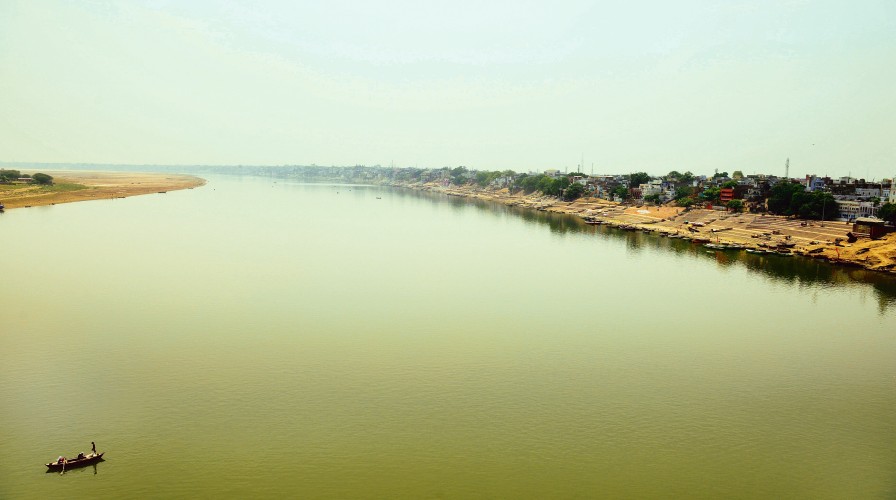
River revitalisation initiatives throughout the Ganga basin gained new impetus when the 68th Executive Committee meeting of India’s National Mission for Clean Ganga authorised a new set of biodiversity, pollution control, and cultural restoration projects.
According to a recent government statement, the meeting’s key goals were to preserve continuous and unpolluted river flows while expediting ecological restoration, biodiversity conservation, and infrastructure implementation. The acceptance of a unique avifauna project aimed at preserving endangered bird species in the Ganga basin was one of the major decisions. The programme aims to preserve the breeding grounds of birds that nest on sandbars, such as the Indian skimmer.
In line with Namami Gange Mission-II, the initiative prioritises evidence-based conservation techniques, community involvement, and long-term monitoring. The Lower Ganga and Chambal sections will continue to be monitored for nests. Monitoring will also start in Prayagraj, Bijnor, and Narora.
The role of local communities will be crucial. Trained locals will promote awareness and capacity-building initiatives, lessen human disturbance, and protect vulnerable sandbars. The initiative completes a wider focus on river-dependent species by extending NMCG’s biodiversity effort, which now includes dolphins, fish, turtles, and mugger crocodiles. In order to facilitate the more seamless execution of ongoing projects throughout the states of the Ganga basin, the committee also approved updated administrative and expenditure clearances.
According to officials, the changes are intended to preserve project momentum, improve resource efficiency, and address operational issues. Authorities therefore anticipate improved punctuality, quality, and transparency in infrastructure and pollution reduction projects.
A 10 KLD faecal sludge and septage treatment facility in Uttar Pradesh’s Mirzapur district and the restoration of Kanpur’s sewage system are two projects that are expected to gain. It was also decided to renovate Kanpur’s main substation. Approvals will enable the trash skimmer project in Varanasi to keep the Ganga’s surface clean.
In the meantime, projects for sewage treatment plants, interception, and diversion at Danapur, Phulwari Sharif, and Fatuha, Bihar, as well as a related project in Phusro, Jharkhand, were supported.
Two significant pollution reduction projects in West Bengal, Garden Reach and Kooraapukur, also received approval for minor changes. By endorsing natural methods for in-situ treatment and revitalisation of important drains in Delhi that flow into the Yamuna, the committee highlighted creativity in pollution control.
The Shastri Park, Gaushala, and Kailash Nagar-Ramesh Nagar drains are all included in the authorised proposal. The method uses aquatic vegetation, stone masonry, and rock filters to naturally purify raw sewage before it enters the river.
The effort has the potential to lower pollutant loads while avoiding energy-intensive treatment technologies, according to officials who hailed it as both eco-friendly and successful. The committee approved a thorough master plan for rehabilitating the Gomti River’s birthplace at Pilibhit, Uttar Pradesh, in an effort to deepen cultural linkages to rivers. For Madho Tanda town, the plan calls for nature-based sewage treatment, water source revitalisation, and catchment area treatment. It also covers lake restoration, turtle habitat preservation, and the construction of ghats and aarti platforms. It is anticipated that supporting facilities, including a cremation, Panchvatika, and a yoga mandap, will preserve the site’s ecological integrity while enhancing its spiritual and cultural importance.
When combined, the permits are meant to strengthen NMCG’s approach to river management that incorporates cultural heritage, nature-based solutions, and biodiversity conservation. The decisions, according to officials, will promote the mission’s overarching objective of sustainable river rejuvenation by enhancing long-term ecological outcomes throughout the Ganga basin and expediting important projects.






Comments are closed