


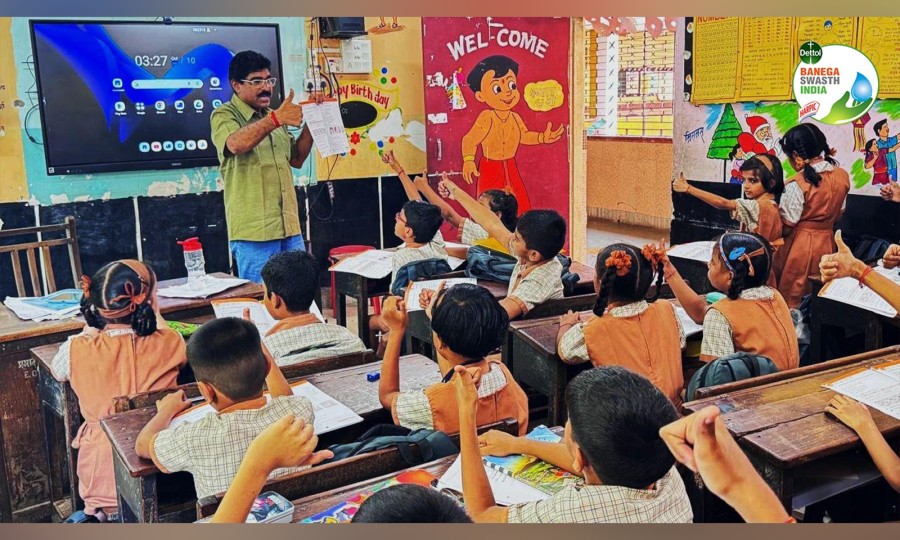
Converting classrooms into immersive centres for hygiene education in order to invest in a healthier, cleaner future generation. On Global Handwashing Day 2025, Reckitt, a leader in consumer health and hygiene, introduced India’s first-ever “Hygiene Building as Learning Aid (H-BaLA)” at Prabhadevi Primary Marathi School in Worli, Mumbai, as part of its flagship Dettol Banega Swasth India (DBSI) campaign. The programme is the culmination of a special approach that incorporates the six Cs: curriculum, communities, collaboration, campus, connect, and children. The revolutionary 6Cs approach known as Hygiene Building as Learning Aid (H-BaLA) is founded on the idea of Early Childhood Development (ECD). This programme helps students by providing a variety of methods to interact with the material, breaking down difficult concepts, and improving retention through practical applications. Instilling a positive call to action #IAmTheChange and making hygiene an essential, happy part of a child’s everyday routine, it symbolises the idea that learning about hygiene should not only be taught but also be experienced.
Dettol Banega Swasth India has spearheaded a strong campaign for behavioural change and hygiene education throughout India over the last 12 years. The initiative, which has reached more than 26 million students in 840,000 schools in 28 states and 11 languages, has promoted healthy behaviours, increased attendance, and established a foundation of hygiene knowledge that permeates communities outside of classrooms. A long-term investment in hygiene for a new generation, Hygiene Building as Learning Aid (H-BaLA) is a programme that reimagines education. Reckitt wants to create a scalable framework for hygiene education across the country by extending the H-BaLA concept to 20 urban cities.
“For more than ten years, Dettol Banega Swasth India has been driving real, measurable changes in how hygiene is perceived and practised among children,” said Ravi Bhatnagar, Communications and Corporate Affairs Director, South Asia, MENARP and Africa, Reckitt, speaking at the launch. The 12-year journey has demonstrated that transformation starts when education and awareness come together. We are strengthening this effect by introducing the Hygiene Building as Learning Aid (H-BaLA) approach, which turns hygiene into a teaching tool that moulds young brains.
This is an investment in the upcoming generation of Indian health advocates, not merely an endeavour. #IAmTheChange is more than just a hashtag; it represents our collective resolve to create a Viksit Bharat by 2047, one healthy child at a time, one clean classroom at a time. “Change becomes lasting when hygiene is part of how children live and learn every day,” said Sai Damodaran, founder and CEO of Gramalaya and Padma Shri Awardee for Sanitation Revolution in India. By skilfully fusing infrastructure with education, the “Hygiene Building as Learning Aid (H-BaLA)” transforms each wall and hallway into a reminder of proper hygiene. I think this model will bring about a long-lasting cultural change by fostering healthy habits from a young age and producing a generation that values cleanliness, dignity, and well-being, having seen India’s sanitation journey progress from awareness to action.




Comments are closed