


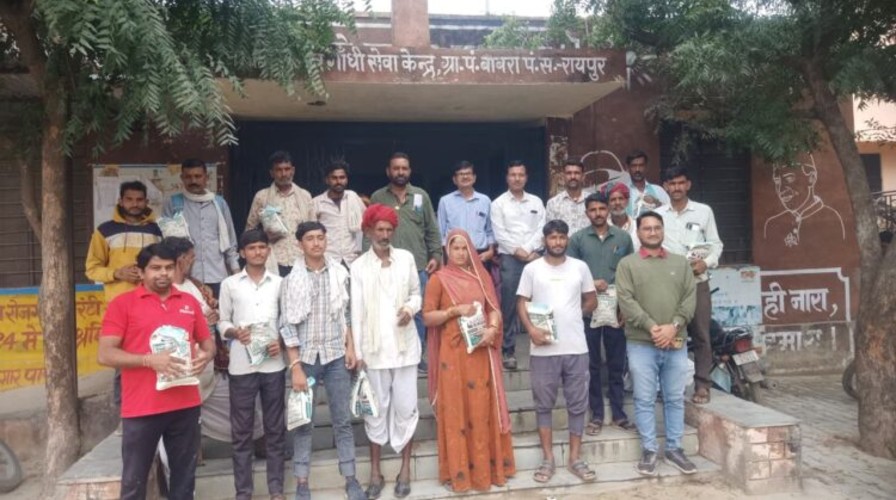
In the 13 gramme panchayats surrounding its Ras and Beawar operations, 1,763 farmers received Almadar three-year lucerne (Rajka) fodder seeds from the Shree Foundation Trust, the social development division of Shree Cement Ltd., one of India’s top cement manufacturers. Enhancing the availability of fodder for livestock and bolstering the income resilience of agricultural households in the area are the two main objectives of the effort.
This reaffirms the business’s dedication to advancing sustainable farming methods and raising rural standards of living in the areas where it operates. It is a component of Shree Cement’s larger initiatives to promote equitable development via skill development, livelihood improvement, and sustainable resource management. Company representatives Ashok Kumar Agarwal (Store Head, Ras), Kushal Sankhla (Electrical Department, Ras), CSR lead Vishal Jayswal, Amit Tak, and executive CSR Jitendra Kumar Dagdi, as well as social workers Devendra Singh Jodha (Gopalpura–Babra) and Sohan Lal Kumawat (Bootivas), were present at the seed distribution drive.
Alfalfa (Rajka) seed of 3,526 kilogrammes was supplied as part of this scheme, with two kilogrammes going to each farmer. The amount of the participants’ voluntary contributions was given to the local government schools to help with school development projects.
“Our community development work focuses on strengthening long-term economic resilience in rural areas,” stated Vishal Bhardwaj, CSR Head of Shree Cement. Our goal is to assist farmers in implementing sustainable and productive farming methods by facilitating their access to high-quality agricultural supplies and offering helpful crop consultancy services. This programme demonstrates our ongoing dedication to collaborating closely with farming communities and fostering the expansion of livelihoods via field-level involvement and capacity-building. In addition to providing seed assistance, the initiative promotes agronomic knowledge exchange, which in turn encourages farmers to embrace sustainable input usage and diverse cropping systems. The goal of the programme is to increase agricultural resilience and help farming people have more stable incomes. It is anticipated to greatly aid in the rearing of cattle and advance regional agricultural sustainability.





Comments are closed