


vivo India has announced 10 educators as Teacher Innovation Fellows under the fourth edition of vivo Ignite 2026, recognising teachers who are using innovative methods to make learning more experiential, inclusive and focused on problem-solving.
The National Teacher Innovation Fellowship (NTIF) was introduced as part of vivo Ignite 4.0 to strengthen STEM education and recognise teachers who are developing new approaches to teaching, experiential learning and inclusive classrooms.
The fellowship attracted more than 200 applications from 14 states and 26 districts across India. After the initial selection, 30 educators were shortlisted for interviews. Following the final evaluation, 10 educators from six states, one Union Territory and 10 districts were selected for the fellowship.
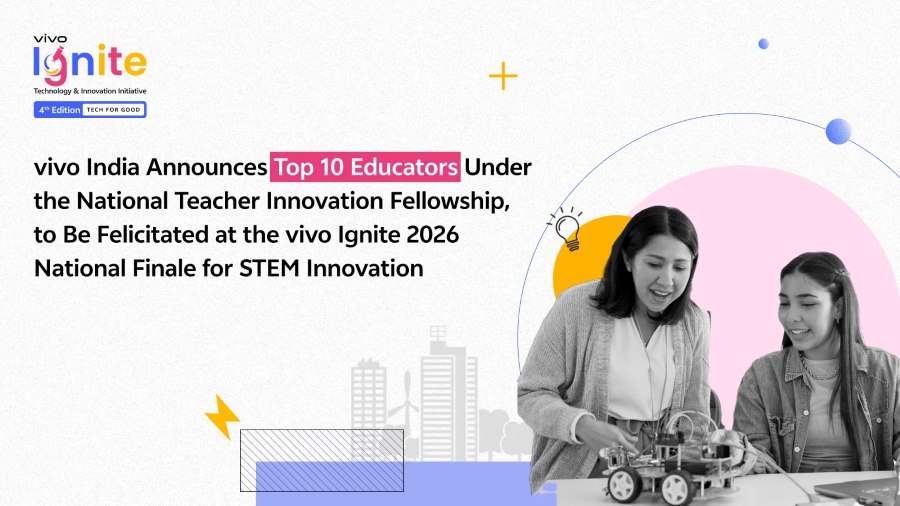
The selection process evaluated educators on four key areas: innovation in teaching practices, inclusive and adaptive teaching, real-world impact and STEM application, and vision, leadership and scale. The evaluation panel included nine experts and academicians from the education, STEM and innovation ecosystem, including representatives from IIT Madras Pravartak Technologies and Science Olympiad Foundation.
The selected fellows bring expertise in areas such as artificial intelligence, robotics, computer science, maker education and inclusive STEM learning. They will be felicitated at the vivo Ignite 4.0 National Finale, scheduled for October 28, 2026, at Bharath Mandapam in New Delhi.
Geetaj Channana, Chief Corporate Communications Officer, vivo India, said, “Teachers play a critical role in shaping how students experience innovation; encouraging them to question, experiment and apply their learning to real-world challenges.”
She added that the diversity of the 10 fellows shows that innovation can grow across different classroom settings and is not limited by resources or geography. Through the fellowship, vivo India aims to encourage experiential and inclusive learning while inspiring more young innovators.
The initiative highlights the role of teachers in helping students connect classroom lessons with real-world challenges and developing skills needed for innovation and STEM-based learning.




Comments are closed