


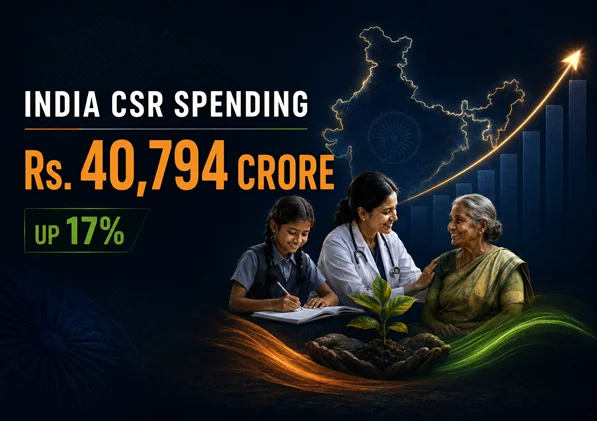
Corporate India’s spending on Corporate Social Responsibility (CSR) activities witnessed a strong rise in the financial year 2024-25, reflecting improved profitability and a growing commitment to social development. According to a recent report, CSR expenditure by eligible companies increased by 17% year-on-year to reach ₹40,794 crore in FY25, up from ₹34,815 crore in the previous financial year. The growth was largely driven by higher corporate earnings, as companies are required under the Companies Act to allocate at least 2% of their average net profits from the preceding three years toward CSR initiatives.
The report highlights that India’s corporate sector has steadily expanded its contribution to community development over the years. As business performance improved across industries, companies allocated larger budgets toward projects aimed at education, healthcare, environmental sustainability, rural development, livelihood generation, and skill enhancement. The upward trend also indicates that CSR has evolved beyond being merely a regulatory obligation and is increasingly becoming an integral part of long-term business strategy.
Education and skill development continued to receive the largest share of CSR funding, followed by healthcare, sanitation, and nutrition. These sectors have consistently attracted significant investments due to their direct impact on improving quality of life and supporting inclusive economic growth. Companies also expanded funding for environmental conservation, renewable energy, water management, and initiatives promoting sustainable livelihoods, reflecting the growing importance of environmental, social, and governance (ESG) priorities in corporate decision-making.
Despite the increase in overall spending, the report notes that the geographical distribution of CSR funds remains uneven. Industrially developed states continue to attract a substantial portion of CSR investments because many large companies operate their manufacturing units and headquarters in these regions. Consequently, several economically weaker districts and remote regions continue to receive comparatively lower funding, highlighting the need for a more balanced allocation of resources across the country.
Since CSR provisions became mandatory under the Companies Act, 2013, corporate contributions toward social welfare have grown consistently. The legislation requires companies meeting specified financial thresholds to spend at least 2% of their average net profits on approved CSR activities. Over the past decade, this framework has helped channel significant private-sector resources into public welfare programmes, supporting national development goals in partnership with governments and non-governmental organisations.
Industry experts believe the continued rise in CSR expenditure demonstrates the increasing maturity of India’s corporate ecosystem. Many businesses are now adopting a more strategic approach by focusing on measurable social outcomes rather than one-time charitable donations. They are also collaborating with local communities, civil society organisations, and public institutions to ensure greater transparency and long-term impact.
With corporate profits expected to remain resilient and ESG considerations gaining greater prominence, CSR spending is likely to maintain its upward trajectory in the coming years. Analysts believe this sustained investment will play an important role in supporting inclusive growth, improving social infrastructure, and advancing sustainable development across India.








Comments are closed