


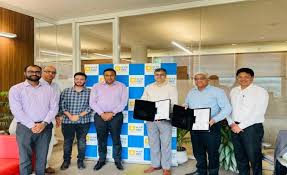
REC Limited has announced a Corporate Social Responsibility (CSR) initiative worth ₹1.40 crore to establish advanced immersive learning labs in 10 government schools in Haryana’s Karnal district. The project aims to modernise classroom education through technologies such as Augmented Reality (AR), Virtual Reality (VR), 3D learning tools, and STEM-based education modules, helping students gain practical and future-ready skills.
The initiative, called the “Green Innovator Immersive Learning Lab” project, will be implemented by the I-Hub Foundation for Cobotics (IHFC), the technology innovation hub of the Indian Institute of Technology (IIT) Delhi. A Memorandum of Agreement (MoA) for the project was signed on May 14, 2026, at REC Limited’s corporate office in Gurugram between REC officials and representatives of IHFC.
The programme is designed to improve experiential learning in government schools by moving beyond traditional textbook-based teaching methods. Through AR and VR technologies, students will be able to interact with digital simulations, visualise scientific concepts, and participate in more engaging classroom experiences. Education experts believe such technologies can make complex topics easier to understand while increasing student participation and curiosity.
Apart from immersive learning technologies, the project will also focus on coding, robotics, innovation, design thinking, and digital literacy. Officials said the initiative is intended to prepare students for an increasingly technology-driven economy where skills related to artificial intelligence, automation, and digital systems are becoming more important.
The project reflects a growing trend in Indian education where schools are incorporating STEM learning and hands-on teaching approaches aligned with the National Education Policy (NEP). Haryana has already been expanding technology-enabled education in government schools through STEM labs and AI-based learning centres. Recent state initiatives have introduced robotics, coding, and artificial intelligence programmes for students from Classes VI to XII to improve innovation and employability skills.
Officials involved in the REC initiative said students in government schools often have limited access to advanced educational infrastructure compared to private institutions. By introducing immersive learning technologies into public schools, the programme aims to bridge the digital divide and create equal learning opportunities for students from different socio-economic backgrounds.
Educational experts have increasingly highlighted the value of experiential learning, where students learn through interaction, experimentation, and practical activities instead of passive memorisation. Studies suggest that immersive tools such as VR and interactive simulations can improve problem-solving skills, creativity, and long-term retention of knowledge.
REC Limited stated that the initiative is part of its broader commitment to strengthening India’s education ecosystem through CSR activities. The company, a Maharatna Central Public Sector Enterprise under the Ministry of Power, has supported several projects in areas such as education, healthcare, women’s empowerment, sustainability, and skill development through the REC Foundation, its CSR arm.
The immersive learning labs are expected to create more interactive classrooms while encouraging students to explore science, technology, and innovation at an early age. Education observers believe such programmes could help government school students become better prepared for future careers in emerging technology sectors.





Comments are closed