


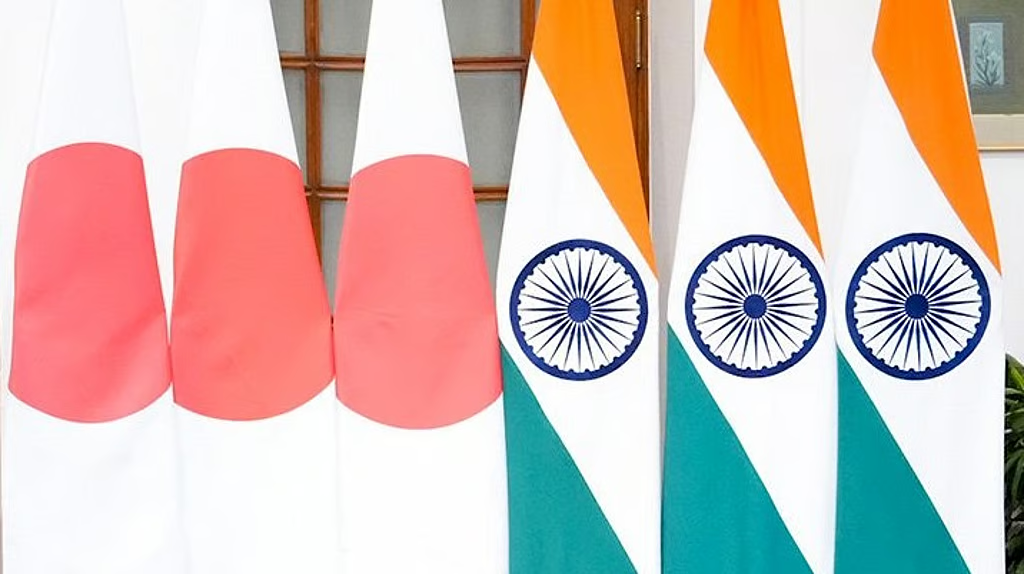
India and Japan have taken a significant step forward in their climate partnership by adopting the Rules of Implementation for the Joint Crediting Mechanism (JCM) under Article 6.2 of the Paris Agreement. The move establishes a formal framework for bilateral cooperation on greenhouse gas reduction projects and is expected to encourage investment, technology transfer and capacity building in low-carbon initiatives across India.
The agreement, adopted on June 8, 2026, provides detailed operational guidelines for implementing joint climate projects between the two countries. It outlines procedures for project approval, monitoring, validation and verification of emission reductions, while also ensuring transparency and accountability through national registries and oversight mechanisms. A Joint Committee comprising representatives from both governments will supervise the implementation process and facilitate cooperation on climate-related initiatives.
The development builds upon a Memorandum of Cooperation signed by India and Japan last year to establish the JCM framework. The mechanism is designed to support projects that reduce or remove greenhouse gas emissions while contributing to sustainable development goals in India. It also enables both countries to count verified emission reductions toward their respective Nationally Determined Contributions (NDCs) under the Paris Agreement.
Article 6.2 of the Paris Agreement allows countries to collaborate voluntarily through the transfer of emission reduction outcomes. Such cooperation is intended to accelerate climate action by enabling nations to share technology, expertise and financial resources. Experts believe the India-Japan partnership could help expand the deployment of clean technologies in sectors such as renewable energy, energy efficiency, sustainable transport and industrial decarbonisation.
The agreement comes at a time when India is pursuing ambitious climate and development goals. The country has been advancing efforts in areas such as renewable energy expansion, green hydrogen, low-carbon transport and industrial transformation as part of its broader transition toward a low-emission economy. Government agencies and policy institutions have highlighted the importance of international collaboration in supporting these objectives and attracting climate-focused investments.
However, the announcement has coincided with growing concerns over emissions associated with liquefied natural gas (LNG) trade in Asia. A separate report has drawn attention to emissions linked to Japan’s resale of United States-origin LNG to several Asian countries between 2020 and 2025. According to the report, the associated emissions are estimated to be equivalent to those produced by approximately 17 coal-fired power plants operating for a year. India has been identified among the top ten Asian destinations for these LNG shipments, alongside countries such as China and South Korea.
The findings have renewed discussions about the environmental implications of LNG as a transition fuel. While natural gas is often promoted as a cleaner alternative to coal, concerns remain regarding methane leakage, transportation emissions and the overall climate impact of large-scale LNG trade. Researchers and policymakers increasingly emphasize the need for accurate emissions monitoring and stronger mitigation strategies to ensure that energy transitions deliver genuine climate benefits.
Despite these concerns, the adoption of the JCM implementation rules reflects a strengthening of India-Japan cooperation on climate action. The framework is expected to support the development of credible carbon reduction projects while fostering innovation, investment and sustainable development. As both countries work toward their climate commitments, the partnership could serve as a model for international cooperation in addressing global environmental challenges.








Comments are closed