


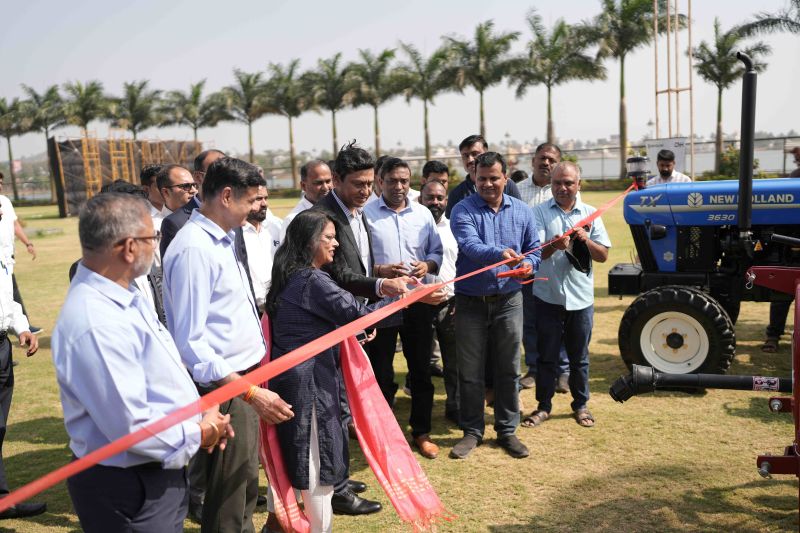
CNH has expanded its flagship Sustainable Environment Solution (SES) programme to South India, marking a significant step in its efforts to promote sustainable agricultural practices and reduce the environmental impact of crop residue burning. The initiative, which has already demonstrated positive outcomes across several northern and central Indian states, will now be implemented in Karnataka and Tamil Nadu, where crop residue management is becoming an increasingly important issue.
The expansion reflects CNH’s long-term commitment to supporting Indian farmers with practical and environmentally responsible solutions. The programme aims to discourage the practice of stubble burning by introducing sustainable alternatives that enable farmers to manage agricultural residue efficiently while improving soil health and creating additional income opportunities.
Implemented in partnership with the Indian Society of Agribusiness Professionals (ISAP), the SES programme combines farmer awareness campaigns, technical training, and access to modern crop residue management equipment. Farmers are educated on the harmful effects of open-field burning, including air pollution, greenhouse gas emissions, and the degradation of soil fertility. At the same time, they are encouraged to adopt methods that convert crop residue into valuable resources.
The initiative promotes both in-situ and ex-situ residue management techniques. Crop residue can be processed into cattle feed, compost, biomass fuel, packaging material, and other commercially useful products. This approach not only reduces pollution but also creates new livelihood opportunities for farming communities by transforming agricultural waste into an economic asset.
CNH’s programme also focuses on strengthening rural entrepreneurship. Farmer Producer Organisations (FPOs), village-level institutions, and local entrepreneurs receive training and support to establish crop residue collection and processing systems. The initiative encourages the use of advanced agricultural machinery, helping farmers clear fields efficiently without resorting to burning.
The SES programme builds on CNH’s extensive experience in promoting sustainable straw management across India. Over the past several years, the company has implemented similar projects in Punjab, Haryana, Uttar Pradesh, Madhya Pradesh, Bihar, Chhattisgarh, Maharashtra, and Uttarakhand. Some of these initiatives have successfully transformed villages into zero-stubble-burning communities, demonstrating that coordinated efforts, technology adoption, and community participation can significantly reduce crop residue burning.
According to CNH, expanding the programme to South India recognises that sustainable farming challenges are not limited to northern states. As mechanisation increases and agricultural practices evolve, farmers across different regions require effective residue management solutions that balance productivity with environmental responsibility.
The company believes that collaboration between private enterprises, government institutions, research organisations, and local communities is essential for addressing the complex issue of crop residue burning. Through continuous awareness programmes, training sessions, and access to modern equipment, CNH aims to help farmers adopt cleaner farming practices while improving operational efficiency.
By extending the Sustainable Environment Solution programme to Karnataka and Tamil Nadu, CNH hopes to contribute to cleaner air, healthier soil, and a more resilient agricultural ecosystem. The initiative reinforces the company’s broader sustainability strategy, which focuses on supporting climate-smart agriculture, improving farmers’ livelihoods, and encouraging responsible natural resource management. As the programme expands, CNH expects it to create lasting environmental and economic benefits for farming communities across South India while further advancing sustainable agriculture in the country.




Comments are closed